

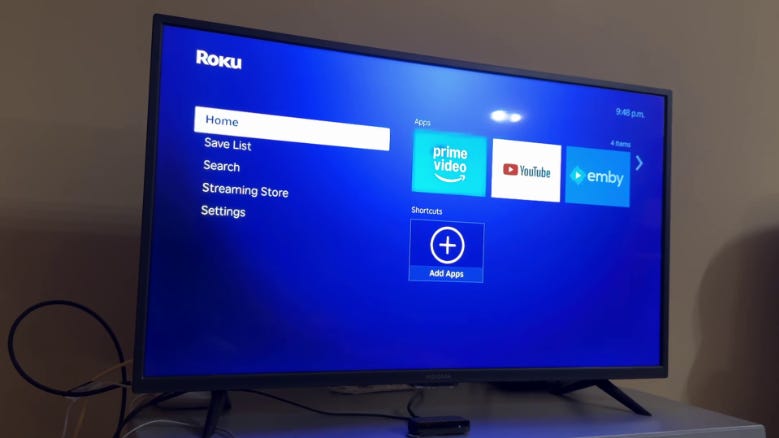
When I heard that Fox was acquiring Roku, my first reaction wasn’t panic. My Mom’s Roku isn’t going to stop working overnight, and there is no reason to believe her favorite apps would suddenly disappear. However, the news forced me to think about something I had been putting off for a while: future-proofing.
My Mom’s TV needs are incredibly simple. She watches YouTube and Emby, occasionally Amazon Prime, and that’s about it. She doesn’t install new apps, browse streaming services looking for something new, or spend time exploring features.
She has a collection of TV series on Emby that she enjoys and a handful of YouTube channels she enjoys. For her, the ideal streaming device is one that stays out of the way and simply works.
Unfortunately, that’s not the direction I feel Roku has been heading.
Roku Isn’t the Same Company It Was
Even before the Fox acquisition, I had concerns about Roku’s direction. Over the years, Roku has become increasingly focused on advertising, recommendations, promoted content, and sponsored themes. While these changes are often relatively minor, they add up over time.
The app icons generally stay where they are, but backgrounds change to match sponsors. New content appears, and new promotions are introduced. The interface slowly becomes busier and more focused on Roku’s business interests rather than the user’s experience.
For a technical user, these changes are usually little more than an annoyance. For someone like my Mom and the least tech savvy among us, they can be confusing because when the TV suddenly looks different. She wonders whether she accidentally did something wrong, or that an update screwed something up.
That’s not the experience I want for her.
The Fox Acquisition Was the Final Push
Nobody knows exactly what Fox plans to do with Roku. The apps my Mom uses will almost certainly remain available because it wouldn’t make much business sense to remove popular services that people rely on every day.
What concerns me is something more subtle. Fox didn’t spend billions of dollars to leave Roku exactly as it is today. Over time, I expect tighter integration with Fox-owned services, more promotion of Fox content, additional advertising opportunities, and a greater focus on Fox’s business interests throughout the platform.
Maybe those changes will be small. Maybe they’ll be significant. Either way, the future direction of Roku suddenly became much less certain. At the exact same time, I was thinking about how to make technology easier for my mom in the years ahead, and the timing felt like a sign that it was time to make a decision.
Why Apple TV Made Sense
The funny thing is that I didn’t buy an Apple TV because it has more features. In fact, I bought it because I expect it to be less intrusive.
Apple certainly adds new features, software updates, and capabilities over time. However, Apple generally takes a different approach to introducing those features. Most of the time, they are things you choose to use rather than things that suddenly appear front and center whether you want them or not.
If my mom wants to use YouTube and Emby, she can simply do that. Apple doesn’t rely on advertising to survive, but Roku does. That’s why the Roku is $50, while the Apple TV is roughly $218 when all is said and done.
The interface will stay focused on the apps she actually uses rather than constantly trying to draw her attention elsewhere. For someone whose needs are so simple, that restraint is actually a major advantage.
It Fits the Devices She Already Owns
Another factor is that my mom already uses an iPhone and a MacBook Air. Because of that, the Apple TV integrates naturally with devices she already understands and uses every day.
Her iPhone can help with setup, password entry, and other tasks that are often frustrating on a television screen and remote. When she needs to take the Apple TV to a house sit, the process should also be relatively straightforward. She can plug it into another television, connect it to Wi-Fi with relative ease, and continue using the same familiar interface she uses at home.
Instead of learning someone else’s smart TV system, she brings her own TV experience with her, which she also did with a Roku. That consistency matters far more to her than having access to a long list of features she will never use.
Reliability Matters
We’ve also had Roku devices fail before. To be fair, any electronic device can fail, but Apple TV has a reputation for long software support and high-quality hardware. The current Apple TV is overpowered for someone who only watches YouTube and Emby, but that’s actually a good thing.
My hope is that five years from now, it will still feel fast, responsive, and reliable. A device that feels overpowered today is less likely to feel outdated later.
Was It Worth the Cost?
The Apple TV cost about $218 Canadian after tax, which is a lot of money for a streaming box. If I were evaluating it purely as a gadget purchase, I would have a hard time justifying the cost.
I am buying stability, predictability, and a platform that I believe is less likely to surprise my Mom with changes she doesn’t want or understand. Most importantly, I am buying peace of mind.
The Goal Isn’t More Features
The goal isn’t to give my Mom more technology. The goal is to make technology disappear into the background so that it never, or rarely, becomes an obstacle.
If she can turn on the TV, open Emby, watch her favorite shows, and never think about the device itself, then the Apple TV will have done its job.
Based on what I know today, however, the Apple TV feels like the safer long-term bet. Sometimes future-proofing isn’t about getting more features. Sometimes it’s about reducing the number of things that can go wrong and increasing the chances that the technology simply stays out of the way.