


You're not alone if you’re feeling lost in the post-Twitter landscape. Twitter (now called X) has changed dramatically, new rules, a new owner, and a lot more noise. So where do you go if you're looking for a familiar social media experience without the baggage?
Bluesky and Mastodon are two of the most popular alternatives. While they both offer timelines and short posts, they’re built on different philosophies. Here’s a friendly breakdown.
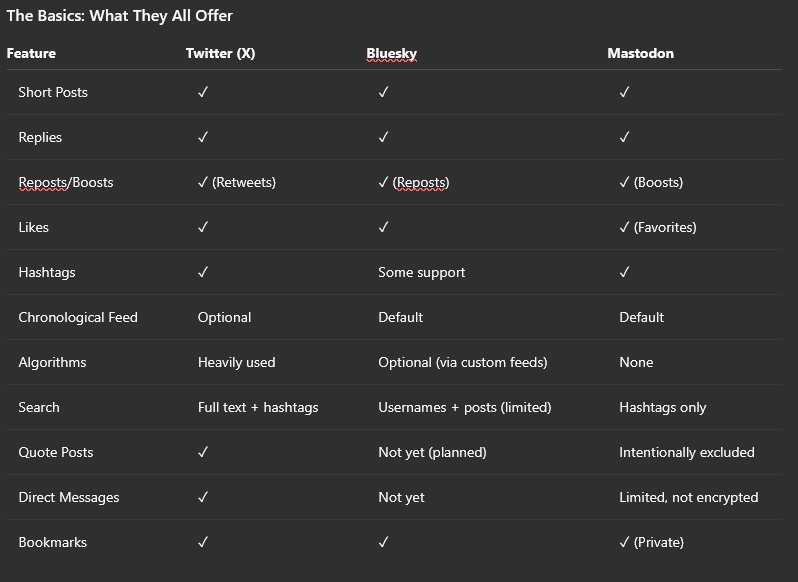
The Basics: What They All Offer
1. User Experience: What Feels Most Familiar?
Bluesky will feel the most familiar if you’re looking for something that looks and feels like Twitter. The interface is clean, replies work the same way, and the posting format is basically identical, just without quote posts or DMs (yet).
Mastodon has a steeper learning curve. It’s decentralized in a way that requires you to pick a “home server” (called an instance), and it uses different terminology like “boost” instead of “retweet.” Once you’re set up, though, it works similarly, with more privacy options and community curation options.
2. Timeline: Who Decides What You See?
Twitter uses algorithms to show you what it thinks you want to see.
That said, the browser extension that makes Twitter usable for me is Control Panel for Twitter. Check out my blog post about it.
Bluesky lets you pick or build custom feeds to customize the kinds of posts that show up. The default is chronological.
Mastodon keeps it old school: strictly chronological timelines with no algorithms at all.
3. Moderation: Who's in Charge?
Twitter/X moderation is top-down and often inconsistent. Content decisions are made behind the scenes.
Bluesky combines platform-level moderation with personal and community moderation services. You can use filters, block users, or rely on community labeling tools.
Mastodon moderation is local to each instance. Each server has its own rules and admins, and servers can block or defederate others. That means you get more say in the community vibe, but it also makes moderation feel more fragmented.
4. Search: How Easy Is It to Find Stuff?
Twitter wins on search. You can search full text, hashtags, usernames, trending topics, you name it.
Bluesky has limited search (currently just posts and users). It’s improving, but it’s still early.
Mastodon has deliberately limited search. This is a privacy decision. Many users don’t want their posts to be searchable by strangers.
5. Content Warnings and Culture
Mastodon has a strong culture of using content warnings (CWs), especially for sensitive topics or politics. It’s baked into the interface and widely expected.
Bluesky encourages labeling posts with content categories (like nudity or sensitive content).
Twitter/X? Let’s just say it’s a free-for-all now.
6. Thinking Ahead and Migration
Twitter/X: You’re stuck. If you lose your account, that’s it.
Bluesky: After setting it up, you can move your account to your own Bluesky server. However, at this point, it’s not easy to do, which means it’s mostly ignored and effectively used the same way as Twitter, where we rely on the main website for now.
Mastodon: You can migrate between servers and take your following/followers with you, though your posts and nothing else don’t transfer.
So… Which Should You Use?
You just want “Twitter, but less awful”? Try Bluesky. It’s friendly, familiar, and evolving fast.
You want strong moderation, control over your space, and a thoughtful community? Give Mastodon a shot.
You want to hang onto the biggest audience, regardless of changes? You’re probably still using Twitter/X.
7. Finding Your People
Bluesky: If you’re looking to find your connections on Bluesky, Sky Follower Bridge is the way to go. Check out my blog post about it here.
Mastodon: There is no method to automatically find your connections on Mastodon, which is a huge deterrent for many to use it, given that you’re effectively starting from scratch. Having said that, if you put in the effort and work through the learning curve, I appreciate what Mastodon offers.
Final Thoughts
There’s no longer a one-size-fits-all solution for a old-school Twitter-like experience. My honest advice is to use each for its own benefits and switch between them.
Having said that, the only thing that makes Twitter usable for me at this point is the Control Panel for Twitter browser extension. Bravo to Jonny for developing that. Please support his work.
Bluesky and Mastodon each offer something Twitter can’t, at least on it’s own: more control. Finding the right fit might take a few tries, but once you do, you might wonder why you waited.
Personally, I’ve found each of these platforms useful in different ways, and I use all three.
I’m using Twitter again because of its still-available features, like full-text search, DMs, and quote tweets, and the people who chose to stay or still post more often there.
In my opinion, Bluesky is the best alternative to Twitter for anyone who wants a similar experience with less noise and more control. It feels the most familiar and is evolving quickly. But at this point, it’s just a better version of what Twitter was years ago.
Mastodon, on the other hand, offers a smaller, more intentional community. I appreciate its strong stance on respect, moderation, and thoughtful interaction—something Twitter has largely abandoned to grab attention and maximize profit. While it’s clear Mastodon won’t become mainstream due to its learning curve and niche appeal, I still think it’s the best place for thoughtful conversations.
Happy posting!
Please Support My Work
Thank you so much for reading this blog post! Your support makes my work possible.
